What Are the Best Carbon Fiber Components for Global Buyers?
Global buyers are looking beyond low weight when evaluating Carbon Fiber Components. They need predictable strength, stable dimensions, clean surfaces, and dependable supply. A racing drone may require thin, rigid arms. An industrial robot may need carbon fiber tubes that resist vibration for years. The application changes everything.
Dr. Stephen Tsai, a respected composite-materials specialist, has said, “Composites are not a material; they are a way of thinking.” That idea remains practical. The best component is not always the lightest one. It must match the load path, operating temperature, joining method, and maintenance plan. It should also come with clear technical data, including fiber orientation, resin system, curing conditions, and inspection results.
Details matter. A buyer should examine surface quality under strong light, check dimensional tolerances, and request batch-level traceability. Test reports should explain methods, not only display impressive numbers. Supplier experience matters too, especially when designs move from prototypes to repeated production. However, specifications can still be incomplete. Real-world impacts, moisture exposure, and inconsistent assembly may reveal weaknesses later. That is where careful validation becomes essential.
No single component wins every project. Carbon fiber plates, tubes, brackets, housings, and custom molded parts each solve different problems. Cost also deserves honest attention. A cheaper part may create rework, delays, or premature replacement. A more expensive design may reduce those risks, but not always. Global buyers need evidence, disciplined comparison, and room for critical questioning before selecting Carbon Fiber Components.
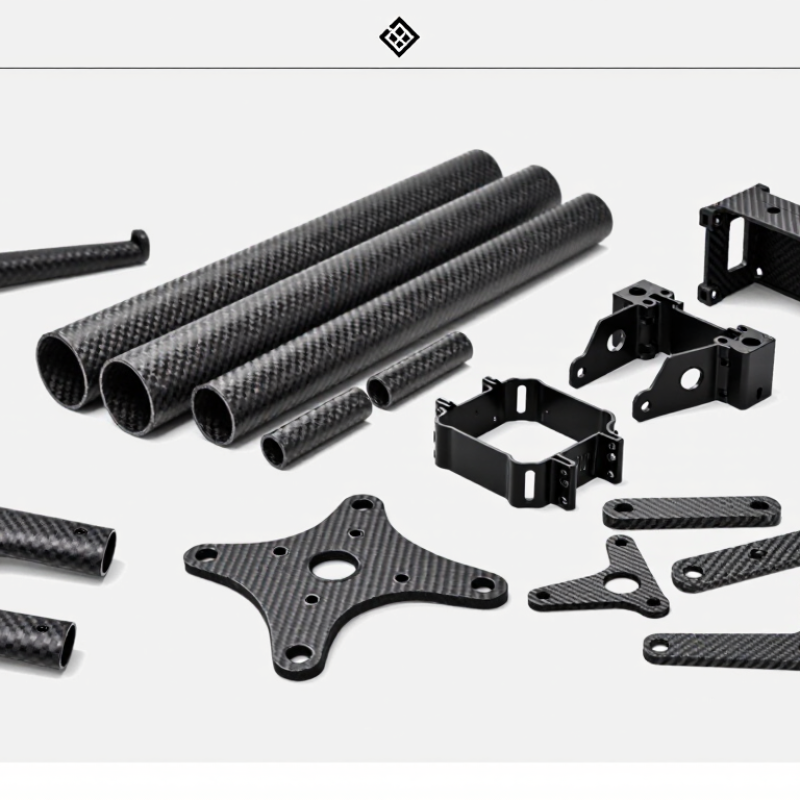
Carbon Fiber Components: Definition, Structure, and Core Advantages
Carbon fiber components are engineered parts made from carbon fibers embedded in a polymer matrix, usually epoxy. The fibers carry most tensile loads. The matrix holds them in alignment and transfers stress between layers. This structure is called a composite laminate. It is not simply “carbon” shaped into a part.
A typical component may contain unidirectional plies, woven fabric, foam or honeycomb cores, and protective surface layers. Fiber direction matters. A tube resists bending differently when its fibers run along the tube than when they cross at 90 degrees. Manufacturers often combine angles such as 0, 45, and 90 degrees. The final layup depends on load, temperature, impact risk, and connection design. Small details matter. A poorly supported bolt hole can crush the laminate, even when the panel looks flawless.
For global buyers, the main advantages are low weight, high specific strength, corrosion resistance, and controlled stiffness. These benefits can reduce transport energy and simplify moving assemblies, but they are not automatic. Carbon fiber can crack under sharp impact, and repair quality varies by process and technician. Buyers should request fiber orientation drawings, resin data, dimensional tolerances, inspection records, and test results relevant to the intended use. I would also question impressive strength numbers without specimen direction, temperature, and test standards. A component may be excellent in one loading case and disappointing in another. That limitation deserves attention before any international purchase.
Key Types of Carbon Fiber Components for International Applications
Global buyers are selecting carbon fiber components for strength, low weight, and corrosion resistance. MarketsandMarkets reports that the carbon fiber market could grow from about USD 3.8 billion in 2024 to USD 5.5 billion by 2029. This growth reflects demand across transport, energy, industrial equipment, and infrastructure.
Key component types include structural panels, pultruded profiles, tubes, brackets, drive shafts, pressure-vessel reinforcement, and molded housings. Panels suit lightweight enclosures and vehicle structures. Tubes and profiles support frames, robotic arms, and inspection equipment. Pressure-vessel reinforcement requires careful fiber placement and resin control. According to ASTM D3039 testing practices, tensile results depend strongly on specimen design, layup, and conditioning. Buyers should request data from the final component, not only raw laminate samples. A spreadsheet never replaces a physical inspection.
Tips: Confirm fiber direction, resin system, surface finish, tolerances, and joining methods before ordering. Ask for batch traceability and test reports. Check performance after heat, moisture, vibration, and ultraviolet exposure. ISO 1268 guidance can support consistent composite specimen preparation. However, test results from one climate may not represent field conditions elsewhere. That limitation deserves attention. Some buyers also overlook repairability, electrical conductivity, and galvanic corrosion when carbon fiber contacts aluminum. A technically strong part can still fail during installation if fasteners, adhesives, or edge protection are poorly selected. The best purchasing decision balances weight reduction, service life, inspection access, and total landed cost.
What Are the Best Carbon Fiber Components for Global Buyers?
Key carbon fiber component types for international applications, ranked by representative weight-saving potential compared with steel equivalents in similar load-bearing applications.
The values show representative midpoint estimates from commonly reported engineering ranges. Actual savings depend on geometry, load requirements, manufacturing method, safety factors, and joining design. Carbon fiber composites typically have a density of approximately 1.5–1.6 g/cm³, compared with about 2.7 g/cm³ for aluminum and 7.85 g/cm³ for steel.
How to Compare Strength, Weight, Durability, and Cost
For global buyers, carbon fiber components should be compared by function, not appearance. Appearance misleads. A glossy surface can hide weak layup choices. Strength depends on fiber direction, laminate thickness, resin quality, and joint design. Ask for tensile, compression, and interlaminar test data. Check the test standard, sample size, and production batch. Without those details, “high strength” is only a sales phrase.
Weight matters when a component moves, rotates, or supports a fixed load. Compare the complete part, including inserts, coatings, bolts, and bonded fittings. A lighter bracket may reduce shipping costs but flex too much during assembly. Measure stiffness at the actual mounting points. For repeated loading, review fatigue results instead of relying on one breaking-load figure. Carbon fiber resists corrosion well, but impacts can cause hidden internal damage. Use visual checks, tap testing, or suitable non-destructive inspection when safety requires it.
Durability also depends on heat, sunlight, moisture, chemicals, and edge protection. Request service-temperature limits and ultraviolet exposure information. Cost should include tooling, inspection, packaging, freight, duties, rejects, and replacement risk. Compare quotations line by line. Small tolerances can change machining and installation costs. I have found no perfect comparison method. Buyers may overvalue a low invoice and undervalue reliable records. Require drawings, traceability, dimensional reports, and clear acceptance criteria before production.
Selecting the Right Carbon Fiber Supplier for Global Purchasing
What Are the Best Carbon Fiber Components for Global Buyers?
Selecting a carbon fiber supplier requires more than comparing prices. Start with the component’s actual working conditions, including load, temperature, moisture, and vibration. A reliable supplier should explain the fiber grade, resin system, layup design, and curing process in clear technical language. Ask for material certificates, dimensional reports, and batch traceability. These documents make quality problems easier to investigate.
Request production samples before approving a large order. Examine surface finish, drilled holes, edge quality, and fiber alignment under strong light. Ask how the supplier controls voids, warping, and resin-rich areas. Testing should match the application, not merely satisfy a generic checklist. Tensile, flexural, impact, and thermal tests may reveal different weaknesses. Small details matter.
Global purchasing also depends on communication. Confirm packaging, shipping terms, lead times, replacement procedures, and export documentation in writing. A supplier that answers quickly but vaguely may create expensive delays later. Production capacity deserves careful verification; impressive factory photos prove little. It is tempting to choose the lowest quotation, but inconsistent tolerances can erase the savings. I would also review sample approval records and inspect the supplier’s quality system when possible. No supplier is perfect. The better question is whether problems are reported early, corrected professionally, and prevented from recurring.