7 Digital Spirit Level Buying Tips for Global Buyers?
Global buyers are not choosing a Digital Spirit Level for display quality alone. They are buying repeatable measurements, durable housing, and fewer installation errors. Construction remains a massive international industry. Global Construction Perspectives and Oxford Economics project worldwide construction output will reach about US$13.3 trillion by 2025. That scale makes small measurement mistakes surprisingly expensive.
Industry reports also show a stronger focus on productivity and digital tools. Deloitte’s 2024 Engineering and Construction Industry Outlook identifies technology adoption, labor shortages, and project efficiency as continuing priorities. A digital level can support these goals when its sensor, calibration, and interface perform reliably. However, a bright screen does not prove accuracy. It may only make an incorrect reading easier to see.
The seven buying tips in this guide examine accuracy, resolution, calibration, battery life, protection ratings, data visibility, and supplier support. Buyers should compare stated tolerances at different angles, not only the best figure on the box. They should also request calibration procedures and verification records. ISO/IEC 17025 provides a useful reference for competent calibration laboratories and reliable measurement results. Not every seller follows this standard, unfortunately.
Consider a windy rooftop, a dusty workshop, or a cold warehouse. Buttons become harder to press, batteries lose endurance, and plastic housings can flex after impact. These details matter more than impressive marketing language. Product specifications can still be incomplete. Therefore, buyers should test samples, inspect manuals, and question unclear claims before placing large international orders. A careful choice protects both project quality and purchasing budgets.
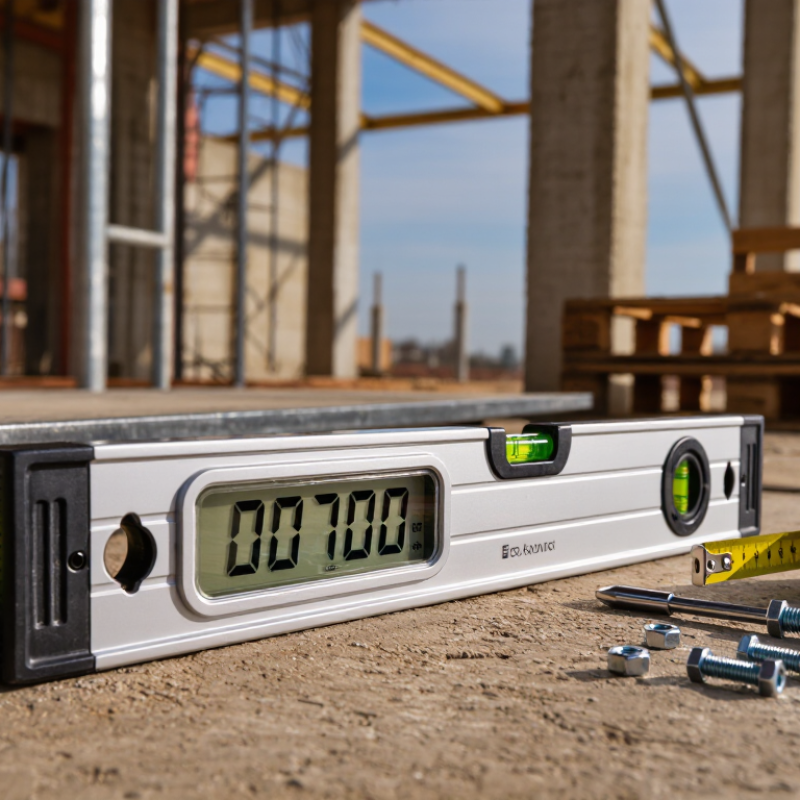
Understanding Digital Spirit Level Types and Core Functions
Choosing a digital spirit level starts with its working environment. A box level suits walls, flooring, and general construction. A torpedo level fits narrow spaces and pipe installation. A digital inclinometer offers more precise angle readings, while a laser-assisted model helps transfer measurements across longer surfaces.
The choice should match the task, not the product’s feature count. Many digital models display degrees, percent slope, and millimeters per meter. Useful functions include audible alerts, display hold, automatic rotation, and zero calibration. Look for an accuracy statement, such as ±0.1° or ±0.2°, and check whether it applies across the full measuring range. An IP rating matters on dusty sites, but water resistance is not waterproofing.
The global construction equipment market reached about USD 207 billion in 2024, according to Mordor Intelligence’s market analysis. That expanding equipment ecosystem increases demand for faster digital measurement tools. Grand View Research also reports strong growth in smart sensors, driven by connected and automated workflows. Yet connectivity is not always necessary. A clear display may outperform an app in bright sunlight or cold weather.
Battery life deserves practical testing. A level that shuts down during repeated alignment wastes time. Calibration is another weak point. Even a premium-looking device can drift after a fall. I would verify it against a known flat reference before critical work. Some users overlook this step. That is a mistake. Rugged housing, readable digits, and simple controls often matter more than extra modes.
7 Digital Spirit Level Buying Tips for Global Buyers: Understanding Types and Core Functions
This chart compares representative display resolutions commonly found in different digital spirit-level formats. A lower degree value indicates finer angle measurement. Actual accuracy, calibration stability, working temperature, IP rating, alarm functions, battery life, and measurement range vary by model, so buyers should verify the technical datasheet before purchasing.
Checking Accuracy, Resolution, and Calibration Features
Accuracy should lead your buying decision, not the display’s extra digits. A digital spirit level showing 0.01° resolution may still have ±0.2° accuracy. That difference matters when aligning machinery, framing walls, or checking long surfaces. NIST Technical Note 1297 explains that measurement uncertainty includes repeatability, resolution, and calibration effects. Ask suppliers for a stated accuracy range, test conditions, and uncertainty information. A simple product claim is not enough.
Test the level in both directions. Place it on a stable surface, record the reading, rotate it 180 degrees, and measure again. The two readings should remain close. ISO 17123-1 provides a useful field-testing framework for checking repeatability and reliability. For practical purchasing, look for repeatability data across several readings, not one impressive laboratory result. Short-term stability is useful, but temperature stability is often overlooked. A cold warehouse and a warm construction site can produce different readings.
Calibration features deserve careful attention. Choose models offering user calibration, a clear zero-setting procedure, and a documented calibration interval. NIST TN 1297 also stresses that traceability does not automatically guarantee perfect accuracy. Calibration can confirm performance, but it cannot repair damaged sensors or unstable housings. I would also inspect the manual before purchasing. If calibration steps are vague, the instrument may become difficult to trust. Resolution looks precise. It is not always precise.
Choosing the Right Length, Display, and Measurement Range
For global buyers, a digital spirit level should match the work, not just the product photo. Tip 1: Choose the length by surface size. A 23-centimeter level suits cabinets and shelves, while a 60-centimeter model checks longer frames more reliably. Tip 2: Consider storage and transport. My first level was too long for a crowded tool case. That mistake still affects my buying decisions.
Tip 3: Select a display that remains readable from an angle. Bright digits help in dim rooms, but excessive glare can be distracting outdoors. Tip 4: Check measurement units before ordering. Degrees, percentage, and millimeters per meter serve different users. A simple unit switch prevents avoidable conversion errors. Tip 5: Match the measurement range to your application. A narrow range may improve focus, while a wider range supports ramps, machinery, and construction checks. Do not assume wider is always better.
Tip 6: Examine resolution and accuracy separately. A display showing 0.1 degrees does not guarantee 0.1-degree accuracy. Look for published tolerance data and calibration instructions. Tip 7: Test the level on a known flat surface after delivery. I sometimes trust factory settings too quickly, and that habit needs correction. Repeat the test in both directions. Also check response speed, button size, battery access, and resistance to dust or splashes. These small details become important when measurements are taken with cold hands or limited visibility.
7 Digital Spirit Level Buying Tips for Global Buyers: Choosing the Right Length, Display, and Measurement Range
| Tip | Buying Dimension | Recommended Specification | Why It Matters | Practical Selection Guidance |
| 1 | Choose the Level Length | 230–600 mm for general work | Longer levels average out small surface irregularities, while shorter levels are easier to use in confined areas. | Choose about 230–300 mm for cabinets, frames, and tight spaces; 400–600 mm for walls, floors, doors, and general construction. |
| 2 | Check the Digital Display | Backlit LCD with 180° viewing | A clear, reversible display improves readability when the tool is held overhead, vertically, or at an angle. | For dim indoor areas or outdoor work, select a backlit display with large digits, automatic orientation, and an adjustable brightness setting. |
| 3 | Confirm the Measurement Range | At least ±90°; preferably 0–360° | A wider range allows the tool to measure horizontal, vertical, and inclined surfaces without restricting the working position. | ±90° is sufficient for most leveling and plumbing tasks. A 0–360° range is more versatile for slope, angle, and fabrication applications. |
| 4 | Compare Accuracy and Resolution | Accuracy: ≤±0.2°; resolution: 0.1° | Accuracy indicates how close the reading is to the true angle, while resolution indicates the smallest displayed increment. | For household installation and basic construction, ≤±0.2° is generally suitable. Select tighter accuracy for machinery alignment or professional fabrication. |
| 5 | Evaluate the Measurement Units | Degrees, percentage, and mm/m | Different markets and trades use different units for slope and inclination, so unit flexibility improves international usability. | Degrees are useful for angle work; percentage and mm/m are practical for drainage, ramps, flooring, and installation projects. |
| 6 | Inspect Durability and Protection | Aluminum body; IP54 or higher | A rigid body helps preserve calibration, while dust and splash protection supports use in workshops and construction environments. | Look for a machined or reinforced aluminum frame, shock-absorbing end caps, sealed buttons, and an IP rating suitable for the intended workplace. |
| 7 | Review Power and Calibration Features | AAA or rechargeable battery; zero-setting function | Reliable power and user calibration help reduce interruptions and allow the instrument to be checked before demanding work. | Choose an automatic shut-off feature to conserve power, a low-battery indicator for international shipments, and a calibration mode with clear instructions. |
Note: Specifications are general purchasing benchmarks. Actual accuracy, protection rating, battery life, and operating temperature should be verified in the product’s technical documentation before purchase.
Comparing Brands, Certifications, Prices, and After-Sales Support
7 Digital Spirit Level Buying Tips for Global Buyers
A digital spirit level should deliver repeatable readings on dusty sites, uneven floors, and bright outdoor walls. I have learned that brand comparison requires more than checking advertised accuracy. Examine sensor stability, display visibility, battery access, and housing strength. A familiar name may offer better documentation, but a smaller manufacturer can provide useful customization. Do not assume either will suit your project.
Tips: Compare certifications carefully. Check the issuing body, certificate number, product model, and validity date. A printed logo alone proves very little. Ask for calibration procedures and test tolerances. If the seller avoids technical questions, pause before ordering. I once trusted a neat specification sheet and missed the operating temperature range. That mistake affected field readings.
Price comparison should include shipping, import charges, spare batteries, calibration, and replacement policies. The cheapest unit may become expensive after one damaged sensor or unavailable screen. Review after-sales support before payment. Reliable suppliers should state response times, warranty limits, repair locations, and return conditions clearly. Test their support with a practical question. The reply often reveals more than the sales page. However, support promises can change, so save written terms and purchase records. No checklist is perfect. Recheck critical measurements with a second instrument, especially when construction tolerances are tight.