

How to Choose the Best Hand Manual Coffee Grinder?
Choosing the best Hand Manual Coffee Grinder starts with understanding why grinding matters. The National Coffee Association’s Spring 2024 National Coffee Data Trends report found that 67% of American adults drank coffee the previous day. More consumers now prepare coffee at home, where grind quality directly affects taste, clarity, and balance.
Coffee professionals often make the same point. James Hoffmann states, “The grinder is the most important piece of coffee equipment.” His view reflects practical experience, not marketing alone. A sharp burr set can produce more consistent particles. That consistency helps water extract coffee evenly. It can also reveal delicate notes hidden by uneven grinding.
This guide will examine burr design, adjustment systems, handle comfort, portability, durability, and cleaning. It will also compare real-world use, not only laboratory claims. A compact grinder may fit beside a travel scale. Its small body can still demand too much force during a light roast. Some models feel smooth for espresso but become tiring for larger doses.
The International Coffee Organization’s coffee market reports show a complex global coffee chain, where quality and consumer expectations continue evolving. That context matters. A higher price does not guarantee better coffee. Nor does a lower price always mean poor performance.
My own judgment may change after longer testing. Hand strength, brewing method, and daily habits are difficult to measure perfectly. The best choice is personal. It should make precise grinding easier, quieter, and more repeatable.
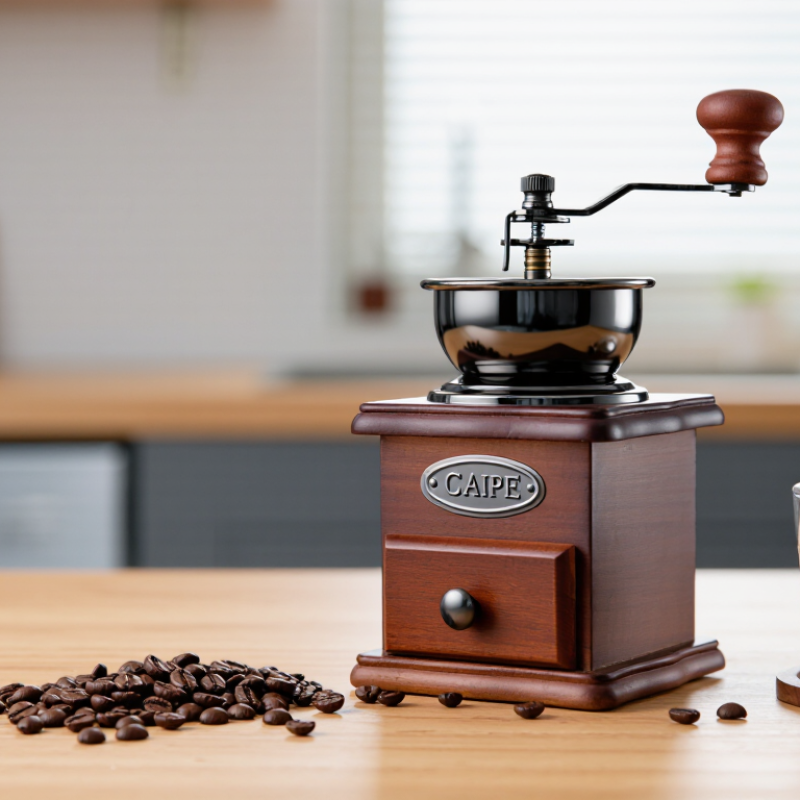
Define Brewing Goals: Target SCA’s 18–22% Extraction Yield
Define your brewing goal before choosing a hand manual coffee grinder. For many filter brewers, the SCA’s 18–22% extraction yield is a useful reference range. It shows how much soluble coffee dissolves from the grounds. A refractometer can measure it, but taste remains essential. A cup at 20% may taste dry with stale beans. A cup at 18% may taste sweet with excellent water.
Choose a grinder that produces consistent particles for your preferred brew size. Burr alignment, adjustment steps, and handle comfort matter more than appearance. Finer particles extract quickly, while coarse particles extract slowly. If your coffee tastes sharp and thin, tighten the setting slightly. If it tastes harsh or dusty, try a coarser setting. Change one variable at a time. I usually begin near the middle of the adjustment range. Then I record dose, water weight, time, and flavor. That notebook often reveals mistakes I blamed on the grinder.
A stable grinder should feel controlled, not exhausting, during repeated turns. Look for low wobble and clear adjustment changes. Do not chase 22% extraction blindly. Some light roasts need longer brewing and careful pouring. Some darker roasts taste balanced below the target range. My own brews are not perfectly repeatable. Humidity, resting time, and pouring rhythm keep changing. That is useful feedback, not failure.
How to Choose the Best Hand Manual Coffee Grinder? — Define Brewing Goals: Target SCA’s 18–22% Extraction Yield
Use the following brewing targets as a practical reference when comparing a manual grinder. Extraction yield should be verified with a calibrated coffee refractometer, while grind settings should be adjusted by taste and brew time.
| Brewing Goal | Typical Starting Data | Recommended Grinder Characteristics | Adjustment Direction | Measurement to Monitor | Practical Selection Note |
|---|---|---|---|---|---|
| SCA-Style Filter Coffee | Coffee-to-water ratio: 55 g/L Typical brew strength: 1.15–1.35% TDS Target extraction yield: 18–22% | Consistent medium-fine particle distribution, stable adjustment steps, and low wobble in the burr assembly. | Grind finer if the brew tastes weak, sour, or finishes too quickly. Grind coarser if it tastes bitter, dry, or finishes too slowly. | Brew ratio, total brew time, beverage mass, TDS, and extraction yield. | Choose a grinder that makes repeatable adjustments rather than one that simply offers the highest number of settings. |
| Pour-Over Brewing | Common dose: 15–30 g Typical ratio: 1:15–1:17 Typical brew time: 2:30–4:00 | Strong control at medium-fine settings, good alignment, and a burr design that limits excessive fines. | Adjust in small increments while keeping water temperature, pouring pattern, and ratio consistent. | Drawdown time, slurry appearance, taste balance, and extraction yield. | A clearly marked adjustment mechanism is useful for returning to a repeatable setting between brews. |
| Immersion Brewing | Typical grind: Medium to medium-coarse Common ratio: 1:15–1:17 Contact time: 3–5 minutes | Smooth operation at coarser settings and enough capacity for the intended batch size. | Grind finer or extend contact time when extraction is low. Grind coarser or shorten contact time when the cup is harsh or over-extracted. | Contact time, agitation, filtration, TDS, and extraction yield. | Capacity and comfortable grinding speed may matter more than extremely fine adjustment steps. |
| Espresso-Oriented Brewing | Typical dose: 18–20 g Beverage mass: approximately 36–40 g Brew ratio: about 1:2 | Very fine adjustment control, low burr movement, rigid bearings, and a comfortable handle for higher resistance. | Make small grind changes because a minor adjustment can noticeably affect flow rate and shot time. | Dose, yield, pressure, flow rate, shot time, TDS, and extraction yield. | Prioritize adjustment precision and mechanical stability; grinding speed is usually secondary to repeatability. |
| Travel and Outdoor Use | Typical personal dose: 15–25 g Priority: Portability and durability | Compact body, protected adjustment parts, secure grounds container, and a handle that stores easily. | Use a consistent recipe and adjust only one variable at a time when brewing with unfamiliar water or equipment. | Grind consistency, ease of cleaning, retention, and time required per dose. | A slightly smaller grinder can be the better choice if it is easier to carry and remains stable during use. |
| Daily Multi-Cup Brewing | Typical total workload: 30–60 g of coffee Priority: Speed and comfort | Efficient burr geometry, comfortable grip, rigid shaft support, and a capacity suitable for the batch size. | Keep the dose and ratio fixed before changing grind size, water temperature, or agitation. | Grinding time, user effort, particle consistency, and repeatability across doses. | Ergonomics and reduced hand fatigue can improve consistency more than a larger adjustment range. |
| Extraction Troubleshooting | Target extraction yield: 18–22% Avoid changing more than one major variable at a time. | Clearly identifiable adjustment steps and predictable changes in grind size. | Low yield or sourness usually calls for a finer grind, longer contact time, higher temperature, or more agitation. High yield with bitterness or dryness usually calls for the opposite. | Record dose, water mass, beverage mass, brew time, grind setting, TDS, and sensory result. | The best grinder is one that makes cause-and-effect testing easy and repeatable. |
| Water and Recipe Control | Brew water temperature commonly falls within 90–96°C, depending on coffee and method. | Consistent particle size so that water temperature and recipe changes can be evaluated without excessive grinder variation. | Standardize water, ratio, temperature, and agitation before judging the grinder. | Water hardness, alkalinity, temperature, ratio, and extraction yield. | Grinder performance cannot be evaluated reliably when water quality or brewing variables change from cup to cup. |