What Are the 2026 Top Industrial Collaborative Robots?

Choosing the best industrial collaborative robots in 2026 requires more than comparing payload figures or glossy demonstrations. This guide examines robots through practical conditions: repeated pick-and-place cycles, tight workspaces, changing product sizes, and operators working nearby. It considers payload, reach, repeatability, programming simplicity, safety features, energy use, integration options, and long-term service support. A robot lifting 20 kilograms may appear powerful, but it could struggle with cable routing, floor space, or frequent tool changes. That matters. The shop floor decides.

The comparison also reflects evidence from manufacturer specifications, independent testing principles, and real deployment experience across assembly, packaging, welding, inspection, and machine tending. We will highlight where each model performs strongly and where its limitations become visible. Data beats hype. Still, no ranking is perfect. Production volume, workforce skills, existing equipment, and regional support can change the final choice. A compact cobot may outperform a larger system in a crowded workshop, while a heavier model may deliver better value in demanding applications. Some specifications are difficult to compare directly, and marketing language can hide integration costs. This article therefore treats “top” as context-dependent, not absolute. Readers should verify current prices, certifications, software compatibility, and service coverage before making a purchase. The strongest industrial collaborative robots are not simply the fastest machines; they are dependable tools that fit people, processes, and measurable business goals.
What Are the 2026 Top Industrial Collaborative Robots?

Industrial Collaborative Robots: Definition and Core Operating Principles

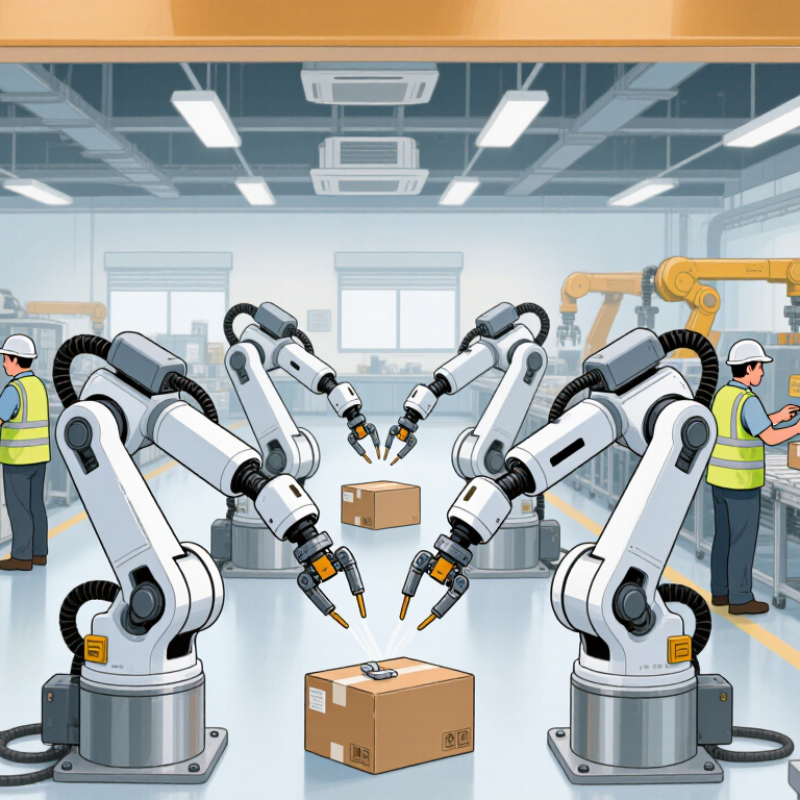
Industrial collaborative robots, often called cobots, are robotic systems designed to work near trained people in shared production spaces. Unlike traditional robots, they combine force sensing, speed control, and monitored safety functions. Their value is practical. A cobot can lift a component, hold it steady, or repeat precise fastening beside an operator. The operator still manages judgment-heavy tasks. This partnership defines collaborative automation.

Core operation begins with task mapping. Engineers identify payload, reach, cycle time, pinch points, and likely human contact. Sensors monitor joint torque, tool force, position, and speed. If resistance exceeds a permitted threshold, the arm slows or stops. Reduced speed and separation monitoring can add protection. A controller coordinates these signals with programmed paths. In a well-designed cell, the robot does not simply move. It responds to changing conditions on a busy factory floor.

The strongest industrial systems in 2026 will be judged by sensing reliability, programming ease, energy use, maintenance access, and verified risk controls. A worker may guide the arm through a motion, then adjust it from a tablet. Simple programming changes do not remove responsibility. A poorly placed fixture can create a hazard, while a sensor may miss an unusual event. Production trials, documented inspections, and operator feedback remain essential. Some installations reveal an uncomfortable truth: collaboration is not always the fastest option.

Key Evaluation Criteria for the Top Collaborative Robots in 2026

In 2026, the top industrial collaborative robots should be judged by measurable production results, not attractive demonstrations. The International Federation of Robotics reported 541,302 industrial robot installations worldwide in 2023, with 4.28 million robots operating globally. This scale raises the standard for collaborative systems. Buyers should examine payload, reach, repeatability, cycle time, and uptime under real factory conditions. A robot that slows after several hours is not a strong candidate.

Safety must be verified through documented risk assessments and relevant international standards. Force-limiting performance, protective stops, speed monitoring, and safe restart behavior matter near workers. Integration is equally important. Check communication protocols, machine-vision compatibility, end-effector support, and programming time. The Association for Advancing Automation reported 31,159 robot orders in North America during 2023, showing how integration capacity affects purchasing decisions. Training and local technical support deserve equal attention.

Total cost is often misunderstood. Include installation, tooling, software, maintenance, energy use, and operator training. Measure payback from actual cycle-time data, not optimistic demonstrations. Cybersecurity should cover user access, network segmentation, updates, and production-data handling. A 2024 Interact Analysis review identified continued growth in collaborative robot adoption, but forecasts can be imperfect. The uncomfortable question remains: can the system maintain quality when materials, operators, and shift conditions change? A short pilot on a real workstation reveals more than a polished showroom test.

Leading 2026 Cobots by Payload, Reach, and Application

What Are the 2026 Top Industrial Collaborative Robots?

The leading 2026 cobots are defined by payload, reach, and application fit. No single model suits every factory. Current industrial systems commonly support payloads from 5 to 20 kilograms. Compact units often reach 800 to 1,000 millimeters. Larger arms can extend beyond 1,500 millimeters. This range matters when loading machines, handling cartons, or reaching across deep fixtures. In real installations, a robot may meet its payload rating but lose speed at full extension. That detail is easy to overlook.

Application design separates strong choices from impressive specifications. Welding tasks need stable motion, torch clearance, and consistent force control. Assembly cells benefit from precise positioning and simple programming. Palletizing requires greater payload, longer reach, and reliable cycle timing. Inspection work often favors lighter arms with smooth movement and integrated vision support. Safety performance also depends on tooling, speed, workspace layout, and a documented risk assessment. Field experience shows that collaborative operation is not automatically safe. It must be engineered and validated.

Tips: Measure the heaviest real payload, including grippers and cables. Test reach at the farthest fixture point. Check cycle time under normal production conditions. Ask for independent safety documentation. A useful pilot may reveal uncomfortable limits. That is valuable. Specification sheets rarely show every practical weakness.

What Are the 2026 Top Industrial Collaborative Robots?

Representative maximum payload and reach by common industrial cobot application

The chart compares representative commercially available collaborative robot configurations, grouped by typical use case. Payload values range from approximately 5 kg for light assembly to 30 kg for heavy material handling, while reach generally increases for machine tending, palletizing, and material-handling tasks. Specifications are rounded published values and may vary by configuration.

Safety, Programming, and Integration Features of Modern Cobots

What Are the 2026 Top Industrial Collaborative Robots?

In 2026, leading industrial collaborative robots will be judged by safety, programming, and integration. Hardware specifications alone are not enough. The International Federation of Robotics reported 541,302 industrial robot installations in 2023, with 4.28 million units operating worldwide. This growth increases pressure on manufacturers to deploy flexible systems without weakening workplace controls.

Safety begins with a documented risk assessment, not a marketing label. Modern cobots should support force and speed monitoring, configurable protective stops, emergency circuits, and safe human access zones. ISO/TS 15066 provides guidance for collaborative applications, but it does not remove the need for application-specific testing. A slow robot can still cause harm. That point is often underestimated.

Programming should allow hand-guiding, graphical task creation, and clear recovery steps after faults. Skilled technicians also need access to APIs, sensor data, and offline simulation tools. Integration matters just as much. Industrial Ethernet, machine vision, safety PLCs, and MES connections should work without excessive custom coding. The best systems shorten commissioning time and preserve useful production data. Still, “easy” programming can hide complex edge cases. Operators need training, readable diagnostics, and permission controls. Field experience shows that these details determine whether a cobot remains productive after the demonstration ends.

Industry Uses, Benefits, Limitations, and Selection Considerations

What makes a top industrial collaborative robot in 2026? The answer depends on the task, not marketing language. The International Federation of Robotics reported 541,302 industrial robot installations worldwide in 2023. Collaborative systems are gaining attention because they fit smaller production cells and changing product lines. The leading categories include six-axis arms, mobile manipulators, high-payload cobots, and vision-guided systems. Common uses include machine tending, packaging, screwdriving, inspection, and pallet preparation. A 12-kilogram arm may place parts beside a worker, while integrated vision checks surface defects under uneven factory lighting.

Their benefits are practical. Faster changeovers. Smaller footprints. Easier redeployment. Interact Analysis has reported double-digit growth expectations for the collaborative robot market through 2028. Yet productivity depends on cycle time, tooling, and material flow. A cobot can be slower than a fenced industrial robot during repetitive, high-volume work. Safety is not automatic. ISO 10218 and ISO/TS 15066 require risk assessment, validation, and limits based on force, speed, tooling, and contact conditions. Sharp parts, unstable loads, or unexpected restarts can still create hazards.

Selection should begin with measured details: payload, reach, repeatability, cycle time, environmental rating, and programming skills. Test the complete process, not just the arm. Ask operators to perform the real handoff. A clean demonstration can mislead. Maintenance access, spare-part availability, and training often matter more than a polished interface. The best choice may be less flexible, but more predictable.

What Are the 2026 Top Industrial Collaborative Robots? - Industry Uses, Benefits, Limitations, and Selection Considerations

A brand-neutral comparison of leading collaborative-robot configurations and the practical criteria used to select them for industrial deployment.

Representative Cobot Profile Typical Payload Typical Reach Typical Repeatability Common Applications Main Benefits Important Limitations Recommended Environment Selection Considerations
Compact Light-Duty Cobot 3–5 kg 500–900 mm ±0.02–0.05 mm
  • Small-part assembly
  • Inspection
  • Laboratory handling
  • Light machine tending
  • Small footprint
  • Low energy demand
  • Easy relocation between workstations
  • Suitable for limited floor space
  • Limited wrist payload
  • Shorter working envelope
  • Less suitable for heavy tooling or large parts
Low-volume manufacturing, electronics, education, laboratories, and compact workcells Check end-effector weight, cable routing, required reach at full payload, and the available mounting space.
General-Purpose Mid-Range Cobot 6–10 kg 900–1,400 mm ±0.02–0.05 mm
  • Machine tending
  • Packaging
  • Pick-and-place
  • Light assembly
  • Broad application coverage
  • Good balance of reach and payload
  • Large ecosystem of grippers and sensors
  • Suitable for frequent changeovers
  • May require guarding at higher speeds
  • Payload decreases as wrist extension increases
  • Not ideal for very large or high-inertia loads
Automotive components, general manufacturing, metalworking, plastics, and consumer goods Compare cycle time at the actual payload and reach rather than relying only on the maximum rated payload.
High-Payload Collaborative Robot 12–20 kg 1,200–1,800 mm ±0.03–0.08 mm
  • Heavy machine tending
  • Palletizing
  • Large-part handling
  • Packaging of dense products
  • Handles heavier tools and parts
  • Can reduce manual lifting
  • Useful where conventional industrial robots are difficult to justify
  • Larger safety distances may be necessary
  • Higher installation and fixture requirements
  • More demanding floor or pedestal stability
Metalworking, automotive supply chains, logistics, palletizing, and heavy component production Validate the complete load mass, center of gravity, inertia, braking behavior, and mounting structure.
Long-Reach Cobot 5–12 kg 1,500–2,000+ mm ±0.03–0.08 mm
  • Large-area machine tending
  • Palletizing
  • Bin picking
  • Multi-machine service
  • Serves several positions from one mounting point
  • Reduces cell footprint in some layouts
  • Useful for deep or widely spaced work areas
  • Lower stiffness at maximum extension
  • Longer cycle times for large movements
  • Greater sensitivity to vibration and deflection
Large machine cells, warehouses, fabrication, and production lines with wide working envelopes Assess deflection, access angles, cable management, collision risks, and cycle time at the farthest point.
High-Speed Pick-and-Place Cobot 3–8 kg 700–1,300 mm ±0.02–0.05 mm
  • Primary and secondary packaging
  • Sorting
  • Consumer-product handling
  • Fast kitting
  • Short cycle potential
  • Fast product changeovers
  • Can support ergonomic automation of repetitive tasks
  • Maximum speed is application-dependent
  • Lightweight products and grippers are usually required
  • Vision and conveyor synchronization can become bottlenecks
Food and consumer goods, packaging, fulfillment, and light assembly Measure the complete cycle, including gripping, vision processing, conveyor tracking, and release time.
High-Precision Assembly Cobot 3–10 kg 700–1,300 mm ±0.01–0.03 mm
  • Screwdriving
  • Press-fit assembly
  • Component insertion
  • Precision inspection
  • Good repeatability for structured assembly
  • Supports force, torque, and vision integration
  • Can improve process traceability
  • Repeatability is not the same as absolute accuracy
  • Fixtures and part tolerances remain critical
  • Force-control performance varies by task and tooling
Electronics, medical-device components, automotive subassemblies, and precision products Specify positional accuracy, force-control needs, fixture repeatability, data logging, and validation requirements.
Washdown or Hygienic Cobot 5–12 kg 800–1,400 mm ±0.03–0.08 mm
  • Food handling
  • Pharmaceutical packaging
  • Wet-area inspection
  • Product transfer
  • Designed for demanding cleaning routines
  • Can reduce direct human contact with products
  • Supports repeatable hygienic handling
  • Hygienic construction can increase cost
  • Not every model is suitable for chemicals or high-pressure cleaning
  • Tooling and grippers must meet the same hygiene requirements
Food processing, beverage, pharmaceutical, and controlled production areas Verify ingress protection, chemical compatibility, cleaning temperature, certification, and the full cell’s hygienic design.
Mobile or Flexible-Deployment Cobot 5–12 kg 800–1,500 mm ±0.03–0.08 mm
  • Shared production resources
  • Small-batch assembly
  • Temporary machine tending
  • Warehouse and intralogistics tasks
  • Can be redeployed between processes
  • Supports changing product mixes
  • May improve utilization of one robot across multiple tasks
  • Navigation, docking, and floor conditions affect availability
  • Revalidation may be required after relocation
  • Mobile bases add complexity and cost
High-mix, low-volume factories, warehouses, laboratories, and flexible production lines Evaluate docking repeatability, battery or charging strategy, wireless reliability, floor flatness, and safety zoning.
Technical figures are representative 2026 selection ranges for industrial collaborative-robot configurations, not manufacturer-specific specifications. Actual performance depends on payload distribution, tool mass, reach, speed limits, safety settings, fixtures, software, and application conditions.
Cross-application selection checklist: Define the task Calculate total payload Validate reach and cycle time Assess risk and safeguarding Check integration requirements Do not select by payload alone

Login