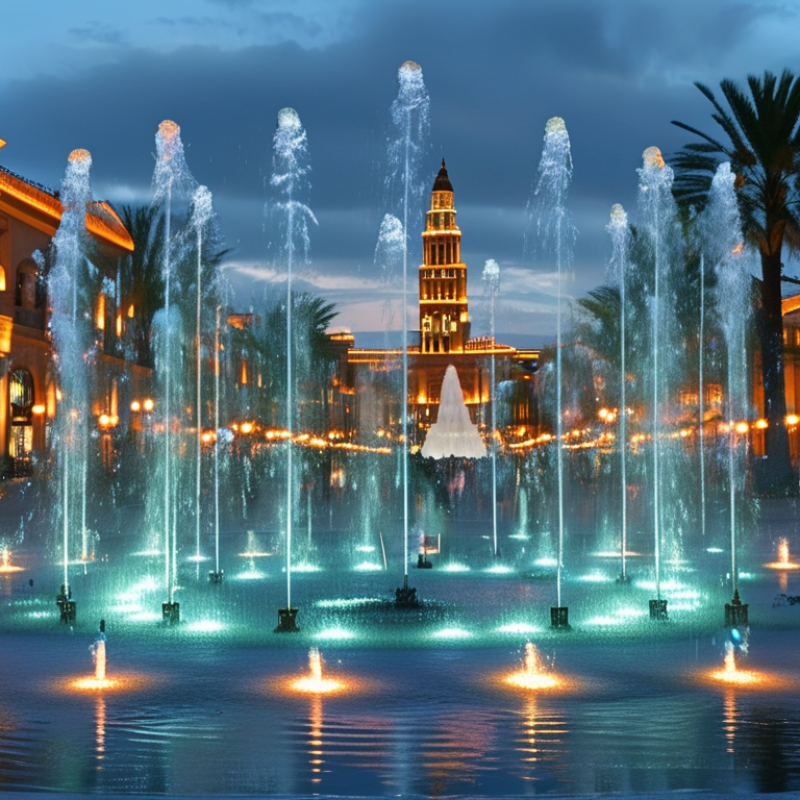
Top 10 Types of Plaza Musical Fountains for Global Buyers

Plaza Musical Fountains transform open public spaces into vivid stages of water, light, music, and movement. They welcome visitors, strengthen a destination’s identity, and create memorable evening experiences. Yet selecting the right system requires more than attractive images. Buyers must examine water capacity, pump performance, nozzle precision, lighting control, sound quality, maintenance access, safety design, and local climate.

WET Design founder Mark Fuller has observed, “Water has a way of bringing people together.” This idea explains why Plaza Musical Fountains remain popular in shopping districts, resorts, civic squares, and cultural developments. A choreographed jet may rise several meters, pause with the rhythm, then fall into a narrow stainless-steel channel. Small details matter. Poor drainage, excessive splash, or weak audio can quickly reduce visitor comfort.

This guide presents the top 10 types for global buyers, including dry-deck fountains, interactive splash fountains, dancing fountains, floating systems, and projection-based installations. Each type offers different visual effects, technical demands, and operating costs. An experienced supplier should provide hydraulic calculations, control-system specifications, installation drawings, and a realistic maintenance plan. Certifications and regional compliance also deserve careful review.

The perfect fountain does not exist. Not every dramatic design fits every plaza. A quieter installation may serve families better than a high-energy show. Seasonal weather, water treatment, accessibility, and long-term staffing can change the final decision. Buyers should compare performance, reliability, and lifecycle value rather than relying only on spectacular renderings. That practical discipline helps turn a beautiful concept into a dependable public landmark.

Top 10 Types of Plaza Musical Fountains for Global Buyers

Plaza Musical Fountain Taxonomy: 10 Types by Water and Music Effects

Plaza musical fountains can be classified by water behavior and musical response. This taxonomy helps global buyers compare performance, maintenance, and visitor experience.

The ten practical types include laminar jets with glass-like streams and gentle melodies; dancing vertical jets with rhythmic height changes; arching jets for lyrical patterns; bubbling geysers for strong, percussive effects; and fan sprays that create broad visual chords.

Other categories include mist fountains, which produce an atmospheric veil; cascading fountains, where water follows stepped levels; interactive ground jets, which respond to movement or programmed cues; rotating nozzles that create sweeping rhythms; and water-screen fountains designed for synchronized visual projection.

In practice, one fountain may fit two categories. That overlap is useful, but it can complicate budgeting and control design. Engineers should assess wind, water treatment, drainage, pump noise, and public access before approving a concept. A beautiful test scene can fail outdoors.

Tips:

Match water intensity to the plaza’s purpose. Use softer effects near seating areas and stronger jets in open celebration zones. Ask suppliers for measured sound levels, nozzle replacement plans, control-system documentation, and maintenance records. Confirm local electrical, accessibility, water-use, and public-safety requirements. Short demonstrations are helpful. Full-scale testing is better.

Dry-Deck, Interactive, Floating, and Programmable Fountain Types Compared

Top 10 Types of Plaza Musical Fountains for Global Buyers

Dry-deck, interactive, floating, programmable, musical, choreographed, linear, jet, mist, and LED-lit fountains serve different plaza conditions. Dry-deck systems hide nozzles beneath flush grilles, allowing children and pedestrians to cross the surface. Interactive fountains respond to touch, motion, or programmed timing. Floating fountains suit lakes and large basins, but wind can distort their patterns. Programmable systems store multiple shows and adjust height, color, and rhythm. Musical fountains add speakers and synchronized lighting. Linear, jet, mist, and LED-lit designs provide narrower visual effects with different maintenance demands.

Grand View Research’s 2024 water fountain market report projects a 5.3% compound annual growth rate through 2030. That growth reflects demand for public spaces with stronger visual identity, not simply more water. UNESCO’s 2024 World Water Development Report notes that agriculture uses roughly 70% of global freshwater withdrawals. Plaza fountains therefore need recirculation, leak detection, and controlled makeup-water systems. Small design choices matter. A poorly sized pump can waste energy every operating hour.

In practice, I would compare nozzle access, filtration, drainage, winterization, noise, and local safety requirements before choosing a style. Dry-deck fountains often improve pedestrian flexibility, yet their underground equipment can complicate repairs. Floating systems look dramatic, but algae and wind remain stubborn problems. Programmable control is valuable, although complex software may become a weakness without trained operators. These details are easy to underestimate. A beautiful test run does not prove reliable operation. Pricing should include service access, water treatment, power demand, and replacement parts over the fountain’s full working life.

Top 10 Types of Plaza Musical Fountains for Global Buyers — Dry-Deck, Interactive, Floating, and Programmable Fountain Types Compared
Rank Fountain Type Typical Water Display Typical Jet Height Water Depth / Basin Requirement Interactive Capability Music and Lighting Compatibility Best-Fit Plaza Application Climate and Site Considerations Relative Planning Cost
1 Dry-Deck Interactive Fountain Flush nozzles produce vertical jets from a paved surface; water drains through concealed grilles and is recirculated. 0.3–3.0 m for most public-play layouts Usually a concealed underground tank; commonly about 0.6–1.5 m equipment-tank depth, subject to hydraulic design. High
Water, pressure, or motion sensors can trigger individual zones.
Excellent; LED fixtures and digitally timed music sequences are commonly integrated. Public plazas, civic squares, retail promenades, family destinations, and pedestrian areas. Requires slip-resistant paving, effective drainage, filtration, and winterization where freezing occurs. Medium–High
2 Programmable Musical Fountain Computer-controlled jets, valves, pumps, lighting, and audio create synchronized choreographies. 1–20 m, depending on nozzle type and visual scale Can use a shallow visible basin or a concealed recirculation tank; depth is determined by pump and nozzle design. Medium
Usually programmed shows rather than direct visitor interaction.
Excellent; supports timed playlists, DMX or comparable lighting control, and show automation. Tourist landmarks, cultural venues, shopping districts, hotels, and large civic developments. Needs robust electrical protection, acoustic planning, water treatment, and scheduled technical servicing. High
3 Floating Musical Fountain Floating platforms carry pumps, nozzles, lights, and control equipment on a lake, reservoir, or large basin. 2–30 m, depending on platform size, wind, and nozzle selection Requires sufficient open water for buoyancy, anchoring, access, and safe operating clearance. Low–Medium
Usually show-controlled; visitor interaction is generally remote.
Very good; wireless or cabled control can coordinate jets, lights, and music. Urban lakes, resorts, waterfront parks, exhibition sites, and large landscape projects. Wind, waves, water level changes, algae, corrosion, boat traffic, and anchoring must be assessed. High
4 Dancing Jet Fountain Multiple directional nozzles create moving, sweeping, crossing, or pulsing water patterns. 1–8 m for typical plaza installations Usually requires a basin or concealed tank sized for changing flow rates and surge volume. Medium
Can be combined with sensors, but most movement is pre-programmed.
Excellent; fast valve response supports rhythm-based choreography and color changes. Event plazas, shopping centers, entertainment districts, and landmark public spaces. Directional nozzles need accurate alignment; wind can affect pattern stability and overspray. Medium–High
5 Laminar Arch Fountain Clear, glass-like water streams form arches between outlets while retaining a smooth, coherent shape. 0.8–4 m Often installed in a shallow basin or dry-deck system with concealed drainage. Medium
Can be arranged as touch-activated or sensor-controlled arches.
Very good; individual streams can be sequenced with LED illumination and music. Architectural plazas, entrances, hospitality developments, and interactive walkways. Needs clean, well-filtered water and stable hydraulic pressure; wind can break the stream shape. Medium
6 Linear Trench or Slot-Jet Fountain Continuous lines or repeated jets are integrated into paving, seating edges, or landscape bands. 0.2–2.5 m Typically uses narrow channels with concealed collection drains and a remote equipment tank. Medium–High
Suitable for proximity sensors and individually controlled zones.
Good; zones can be sequenced with music and architectural lighting. Long plazas, pedestrian streets, transit forecourts, commercial frontages, and narrow sites. Requires precise paving coordination, accessible maintenance covers, and reliable drainage performance. Medium
7 Mist and Fog Fountain Very fine water droplets create a cooling cloud, atmospheric effect, or illuminated haze rather than tall jets. 0.5–3 m mist plume height Usually uses a concealed reservoir and high-pressure pump system; no deep public basin is required. High
Motion, temperature, humidity, or occupancy sensors can control operation.
Good; lighting is especially effective at night, while music is usually an optional layer. Hot-climate plazas, gardens, event spaces, museums, resorts, and shaded pedestrian areas. Wind disperses mist; nozzles require careful filtration and cleaning, and local water-quality rules may apply. Medium
8 Cascade and Sheet-Water Fountain Water flows over stepped surfaces, weirs, walls, or precision edges to create continuous curtains or cascades. 0.3–6 m fall height Requires collection basins, weirs, waterproofed structures, and recirculation tanks; public access depth is normally shallow. Low–Medium
Flow rates and zones may be remotely adjusted but are less commonly touch-activated.
Good; lighting and music can emphasize flow changes and programmed transitions. Terraced plazas, memorials, hotel forecourts, landscape walls, and architectural entrances. Waterproofing, splash control, mineral deposits, and safe edge detailing are key design concerns. Medium–High
9 Aerated Geyser and Bubbling Jet Fountain Large, foamy, oxygenated columns or bubbling jets create a strong visual effect with relatively simple nozzle geometry. 0.5–10 m Generally needs a basin or concealed tank with enough volume to manage turbulence and return flow. Low–Medium
Can be zoned and timed, but direct interaction is not usually the primary feature.
Good; works well with color-changing lights and slower musical compositions. Large civic basins, parks, resorts, roundabouts, and landscape focal points. Often more tolerant of minor water-quality variation than fine laminar systems, but still needs filtration and cleaning. Low–Medium
10 Water Wall and Curtain Fountain A vertical wall, transparent sheet, or narrow curtain of water forms an architectural backdrop or visual screen. 1–8 m wall or curtain height Requires a concealed trough, collection basin, waterproofed wall structure, and recirculation equipment. Low
Usually visual and programmable rather than intended for physical visitor interaction.
Very good; linear lighting and gradual audio programming suit architectural presentations. Building entrances, hospitality areas, cultural venues, interior courtyards, and boundary features. Indoor installations need humidity control; outdoor versions require wind, splash, scale, and mineral-deposit management. Medium–High
Planning ranges are typical industry design values rather than fixed specifications. Final jet height, tank size, pump capacity, energy use, water treatment, accessibility provisions, and winterization requirements should be confirmed through site-specific hydraulic, structural, electrical, and local-code design.

Engineering Data: 0.5–20 m Jets, Pump Flow, DMX512, and IP68 Protection

Top 10 Types of Plaza Musical Fountains for Global Buyers

Engineering Data: 0.5–20 m Jets, Pump Flow, DMX512, and IP68 Protection

A plaza musical fountain should be selected by hydraulic performance, not appearance alone. Jet heights commonly range from 0.5 to 20 meters, requiring careful pump and nozzle matching. For a 20-meter vertical jet, ideal water velocity approaches 19.8 m/s before friction losses. In practice, designers often allow higher discharge pressure and safety margins. A 50 mm nozzle flowing at 20 m/s delivers approximately 141 m³/h. Real flow varies with nozzle geometry, pipe length, and elevation.

Pump sizing must include every active nozzle, filtration loss, pipe resistance, and operating reserve. U.S. Department of Energy pumping-system guidance stresses system-level efficiency rather than motor efficiency alone. That matters during long evening shows. Oversized pumps waste energy. Undersized pumps create weak, uneven columns. I have seen attractive layouts fail because the hydraulic calculation ignored simultaneous operation. The drawing looked perfect.

DMX512 control enables timed changes in height, light intensity, and movement across fountain zones. Use separated power and signal paths where possible. Good grounding remains essential.

For outdoor equipment, IP68 protection is specified under IEC 60529, but the test depth and duration are not universally identical. They must be stated by the supplier. Water can still enter through damaged seals or poor cable glands. A datasheet is not proof of installation quality. Test access, drainage, emergency stops, and maintenance clearance before approval.

Global Buyer Standards: IEC 60364, ADA Access, and Water-Reuse Systems

Top 10 Types of Plaza Musical Fountains for Global Buyers

Global Buyer Standards: IEC 60364, ADA Access, and Water-Reuse Systems

Plaza musical fountains vary from dry-deck jets and interactive splash pads to floating stages, perimeter cascades, and choreographed water walls. Each type creates different risks for wiring, drainage, maintenance, and visitor movement. IEC 60364 provides a strong reference for electrical installations, including protective bonding, separation, and equipment selection. Local regulations must still be checked before construction. One standard rarely answers every site question.

Accessibility requires more than adding a ramp beside the fountain. Under ADA principles, buyers should review clear routes, stable walking surfaces, reachable controls, and safe edges around wet areas. Interactive jets should allow wheelchair users to approach and participate. Musical controls need visible and tactile options where practical. Keep routes clear. Water spray can make surfaces slippery, even when drawings appear compliant.

Water-reuse systems can reduce demand through collection tanks, filtration, disinfection, and monitored dosing. Designers should separate makeup water from overflow and provide easy access for cleaning. A visible water-level indicator helps operators respond quickly. Yet reuse is not automatically efficient. Poor filtration may increase maintenance, odors, or shutdowns. I have seen attractive concepts lose reliability because service access was treated as an afterthought. Testing should include peak visitor loads, wind-blown spray, power interruptions, and seasonal drainage. A modest design with dependable controls often serves global buyers better than a spectacular system that is difficult to inspect.

Selection Matrix: Climate, Footfall, Budget, Energy Use, and Maintenance Needs

Top 10 Types of Plaza Musical Fountains for Global Buyers

A useful selection matrix compares climate, footfall, budget, energy use, and maintenance needs. Dry-deck fountains suit public squares where visitors walk through the water zone. Interactive fountains attract families, but sensors require frequent cleaning. Musical jet fountains create strong visual impact for evening programs. Dancing jets need precise valves and careful programming. Laminar jets provide clear, glass-like streams, though wind can disrupt them. Ring fountains fit formal plazas with controlled circulation. Wall fountains work well beside buildings and use limited floor space. Floating fountains suit large ponds, but water quality becomes critical. Fog fountains create atmosphere, yet humidity can reduce visibility. LED-lit fountains improve night appeal, but lighting raises replacement costs.

Climate should guide every decision. In freezing regions, designers need reliable drainage and winter protection. Hot climates demand shade planning, filtration, and water-level monitoring. High footfall favors robust stainless-steel components and safe, non-slip surfaces. A lower-budget project may choose fewer jets and simpler lighting. This can still look refined. Energy use depends on pump size, operating hours, nozzle height, and lighting control. Variable-speed pumps often reduce consumption during quiet periods. Maintenance teams should inspect filters, nozzles, cables, and water chemistry on a fixed schedule. Salt, dust, leaves, and sunscreen can quickly affect performance. One weakness in many plans is underestimating labor costs. A beautiful fountain becomes a burden when spare parts, access panels, or drainage were considered too late.

Top 10 Types of Plaza Musical Fountains for Global Buyers

Selection Matrix: Climate Adaptability, Footfall Suitability, Budget Accessibility, Energy Efficiency, and Maintenance Ease

Indicative planning scores are based on typical system characteristics, installation complexity, operating requirements, and lifecycle considerations. Higher scores indicate a more favorable fit for the relevant buyer criterion; final selection should be verified through site-specific engineering and local climate data.

Login