What Are the Top Types of Automatic Robots?
An automatic robot can move, sense, or perform a task with limited direct human control. The term covers very different machines. A robotic arm may weld car panels inside a guarded factory cell, while a mobile robot rolls through a warehouse carrying bins. They are not interchangeable, even when both are described as automated.
This guide introduces the main types: industrial robots, collaborative robots, automated guided vehicles, autonomous mobile robots, and service robots. It also explains where humanoid robots fit, and why their human-like shape does not automatically make them more useful. The labels can be messy. Some machines combine features from several categories, and product descriptions do not always use terms consistently. That deserves a closer look.
Choosing a robot begins with the task, not the trend. Consider the payload, reach, floor layout, operating speed, and how people share the workspace. A robot moving boxes down a clear aisle has different needs from one handling delicate parts beside an operator. Safety features, maintenance support, integration costs, and verified performance data matter too. Check specifications against the actual work environment; marketing claims alone are not enough. No single robot type is best for every business. The sections ahead compare their typical roles, strengths, and limits, helping readers identify which options may fit—and what questions still need answering.
Industrial Robot Families: 541,302 Units Installed in 2023 (IFR)
The International Federation of Robotics reported 541,302 industrial robot installations worldwide in 2023. That figure measures new installations, not every robot operating on factory floors. It still shows how widely automation has spread. A welding cell, a palletizing station, and a compact assembly bench may all use very different machines.
Industrial robots belong to several families. Articulated robots use rotating joints to reach around fixtures and handle tasks such as welding or material movement. SCARA robots suit fast, repeated assembly on horizontal planes. Cartesian robots travel along straight axes, often for precise movement across a defined work area. Delta robots are built for quick picking, especially with lightweight items. Collaborative robots are designed to work near people under appropriate safety controls. Useful distinctions, but not a complete guide.
The 2023 installation total does not tell us which family performed best, or why a factory chose one. Applications, payloads, reach, cycle time, and workplace layout all matter. A small detail can change the decision: a cable route, a cramped corner, or a part that shifts in its tray. Robot categories simplify comparison. They can also hide awkward trade-offs.
What Are the Top Types of Automatic Robots? — Industrial Robot Families: 541,302 Units Installed in 2023 (IFR)
| Robot family |
Motion structure |
Typical industrial tasks |
Common strengths |
| Articulated |
Rotating joints arranged like an arm; commonly four to six axes. |
Welding, painting, machine tending, material handling, and assembly. |
Flexible reach and movement around obstacles; widely adaptable to different work cells. |
| SCARA |
Two parallel rotary joints provide horizontal motion, typically with vertical movement at the tool. |
Small-part assembly, pick-and-place, packaging, and dispensing. |
Fast, precise movement in a horizontal work area; well suited to repetitive assembly. |
| Cartesian / gantry |
Linear movement along three perpendicular axes. |
Machine loading, palletizing, dispensing, and handling large or heavy workpieces. |
Straightforward rectangular work envelope and high rigidity; travel can be extended along the axes. |
| Parallel / delta |
Multiple linked arms connect a fixed base to a moving platform or tool. |
High-speed picking, sorting, and packaging of lightweight items. |
Low moving mass enables rapid motion and short cycle times within a compact work area. |
| Cylindrical |
Rotational movement around a vertical axis combined with linear movement. |
Machine tending, material handling, and operations around a central work area. |
Compact base and a cylindrical work envelope suited to certain confined layouts. |
|
2023 global context: The International Federation of Robotics (IFR) reported 541,302 industrial robots installed worldwide in 2023. The figure is the total across robot types; no family-level installation counts are shown here.
|
Articulated Robots: Six-Axis Flexibility for Complex Manufacturing
Articulated robots use six rotating joints to position a tool across a wide range of angles. That flexibility suits tasks such as welding around a frame, loading machine tools, and moving parts between fixtures. An operator can guide the arm’s torch or gripper along curved paths that would challenge a fixed-axis machine. Small details matter: a cable snag, a crowded workcell, or an awkward fixture can limit motion. Six axes do not guarantee a good result.
The industry is scaling up. The International Federation of Robotics reported 4,281,585 industrial robots operating worldwide in 2023, with 541,302 installations that year, in World Robotics 2024. That figure covers industrial robots overall, not articulated arms alone. For a specific line, engineers should check payload, reach, cycle time, repeatability, and tool weight against the actual task. Then test the path with real parts. A wrist may approach a weld neatly in simulation, yet collide with a clamp on the shop floor. Programming also takes care; near certain joint alignments, the arm may need a different route. I would not select a six-axis robot on flexibility alone. It can be the wrong fit when the job is simple, repetitive, and better served by a more constrained system.
SCARA and Delta Robots: High-Speed Assembly and Picking Applications
SCARA and delta robots suit different kinds of fast work. A SCARA robot moves quickly across a horizontal plane, making it useful for inserting components, fastening small parts, and loading compact assembly fixtures. A delta robot uses lightweight arms suspended above the work area. Its parallel motion is well suited to sorting and picking small items from a moving belt. Think of placing a plastic cap into a tray or dropping a connector into a nest. The right choice depends on payload, reach, accuracy, and how items arrive—not speed alone.
The International Federation of Robotics’ World Robotics 2024 report recorded 541,302 industrial robot installations worldwide in 2023, the second-highest annual total on record. That figure covers industrial robots broadly, not SCARA or delta models specifically; it signals a growing automation landscape, not a type-by-type market share.
In practice, measure cycle time with the actual gripper and part. A light tool may move quickly, but product wobble, belt tracking, or a crowded pickup zone can erase the gain.
That sounds simple. It rarely is.
Operators should also check changeover time and access for cleaning or maintenance. A fast cell that is difficult to reset can disappoint. Even a small trial run can reveal missed picks, awkward handoffs, or vibration that a specification sheet will not show.
Collaborative Robots: Over 55,000 Units Installed in 2023 (IFR)
What Are the Top Types of Automatic Robots?
Collaborative robots, or cobots, are designed to work near people on suitable tasks. In 2023, more than 55,000 were installed worldwide, accounting for about 10.5% of new industrial robot installations, according to the International Federation of Robotics’ World Robotics 2024 report. The same report counted 541,302 industrial robot installations overall. That scale makes cobots a significant category, though not the dominant one.
A cobot might hold a small component while a technician fastens a screw, or move parts between a tray and a workbench. Its compact footprint can help in facilities where a full fenced cell would be difficult to fit. But “collaborative” does not mean automatically safe in every setup. The tool, payload, speed, and workspace all affect risk, so each application needs a careful assessment. A poorly planned handoff can still cause delays—or injury.
IFR’s figures count installations, not how many tasks cobots perform or how productive each deployment becomes. That distinction is easy to miss. The data shows growing adoption, but it cannot prove that every factory benefits equally. For buyers, the useful question is practical: can a cobot handle a repetitive task reliably while leaving people with clear, manageable work?
Autonomous Mobile Robots: 113,000 Professional Units Sold in 2023 (IFR)
What Are the Top Types of Automatic Robots?
Autonomous Mobile Robots: 113,000 Professional Units Sold in 2023 (IFR)
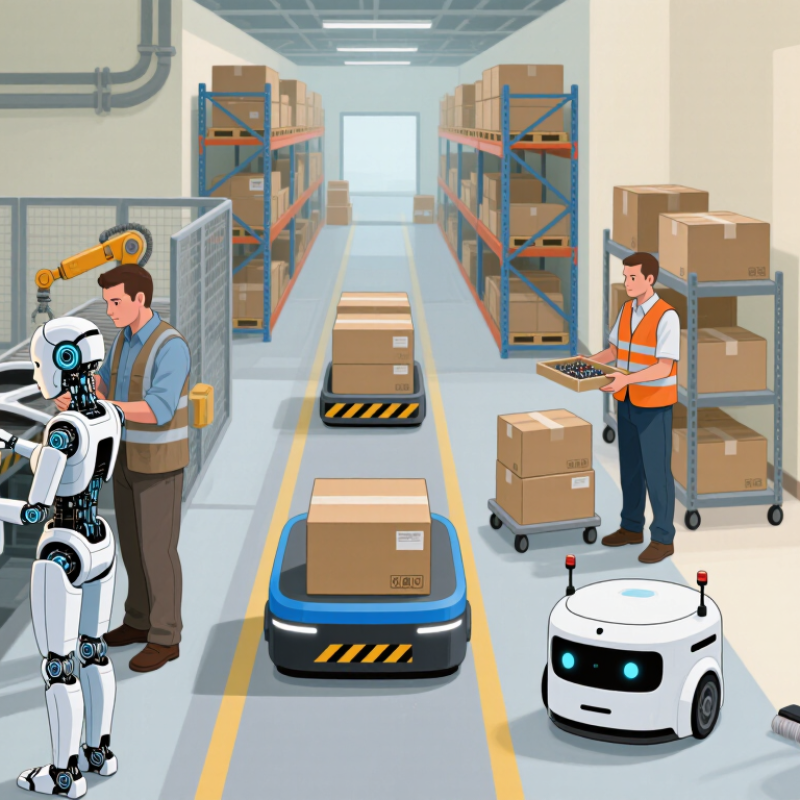
Autonomous mobile robots, or AMRs, move materials through workplaces without fixed tracks. The International Federation of Robotics reported 113,000 professional AMR units sold in 2023. This figure highlights growing commercial adoption, but sales alone do not show how many robots are operating today. Nor does one annual figure explain whether a deployment is effective.
In a warehouse, an AMR might carry a tote from a picking area to a packing station. Sensors help it detect obstacles and adjust its route. That flexibility can reduce repetitive transport work, though it does not remove the need for careful planning. Narrow aisles, changing layouts, and busy pedestrian zones can still create delays. A robot is not automatically a productivity gain.
Tips: Check route width, floor conditions, and handoff points before deployment. Track completed deliveries and interruptions, not just units purchased. Small tests reveal problems early. One limitation: reported sales figures can be hard to compare when categories and reporting methods differ.